There is a Chinese expression that I really like: "Wànsuì". Literally, “ten thousand years.”
It is often translated as “long life,” but that's not really what it means. It is not an individual wish. It is a projection. A way of saying:
what matters is not tomorrow, or even the day after tomorrow, but what lasts over time.
In the West, we talk about China as if it were a recent phenomenon. A giant factory that appeared at the end of the 20th century. An economic anomaly. An industrial “problem.”
But China is not a young country on the rise.
It is the oldest continuous political civilization still active. A state that thinks in centuries, sometimes millennia, where we think in terms of terms of office, quarters, and election cycles.
And inevitably, that changes everything.
We are looking at China twenty years too late
For a long time, the dominant narrative was simple:
China copies. China assembles. China produces at low cost.
This narrative was not entirely false. It was just incomplete.
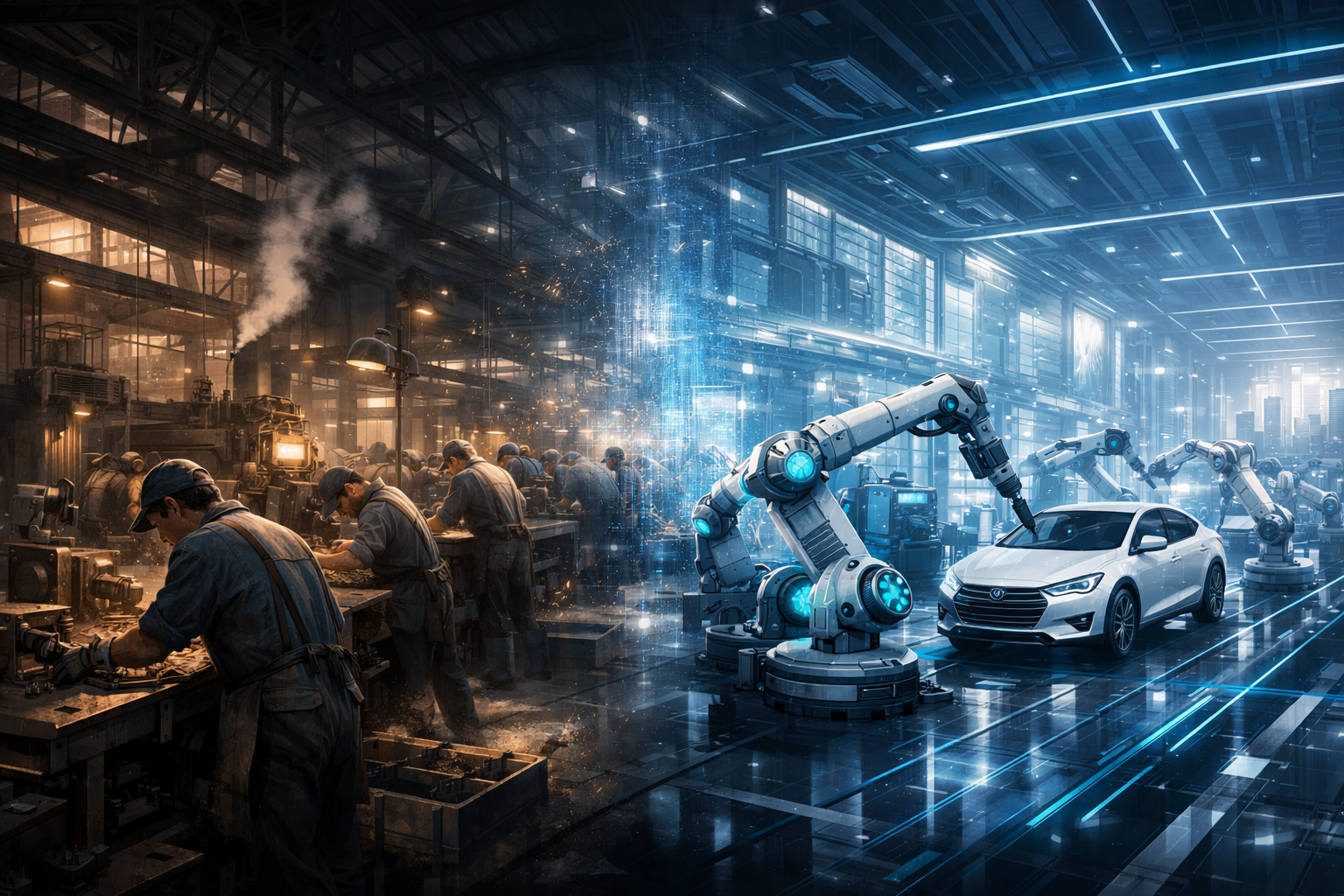
What we took for granted as inevitable — “the world's factory” — was in fact a phase. A necessary step. Almost methodical.
Accepting to be the global workshop means absorbing production lines, understanding processes, mastering logistics, and learning from competitors.
In the West, we believed that this position was a limitation.
In China, it was a learning ground.
In Chinese culture, copying is not taboo.
In calligraphy, for example, originality is not sought from the outset. Masters are copied over and over again until the gesture becomes natural. Originality comes after mastery.
From manufacturing to design: a logical shift
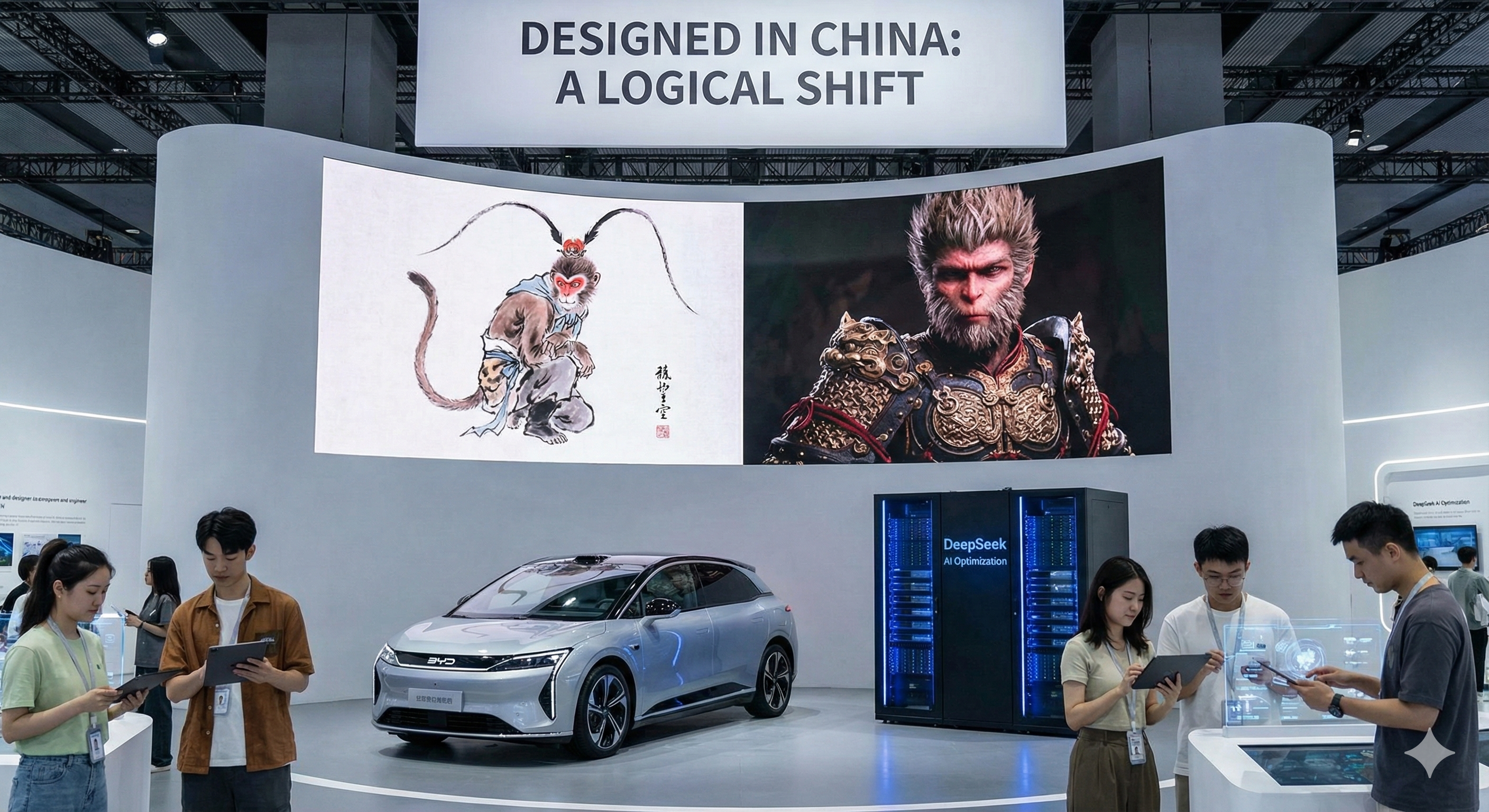
The transition from Made in China to Designed in China is not a sudden break.
It is a logical continuity.
Today, when I look at certain Chinese projects, I no longer see an industry that is “catching up.”
I see a culture that is finally embracing its ability to create.
Objects, platforms, visual universes, video games, interfaces, artificial intelligence.
Not to seduce the West, but to structure its own ecosystem.
Take video games, for example.
When Black Myth: Wukong was unveiled, many initially saw it as a “Souls clone.” A technical demonstration. A nice trailer.
But those who took the time to look understood something else:
a Chinese studio that has mastered Unreal Engine 5 at the highest level, adopting the codes of a demanding Western genre while injecting its own mythology into it. An adaptation of the legendary tale “Journey to the West” (also the initial inspiration for the manga Dragon Ball).
It's not just an imitation, it's a masterful appropriation.
The game isn't just beautiful, it's selling like hotcakes. So much so that a sequel is already in the works, Black Myth: Zhong Kui.
The same logic applies to the automotive industry.
Just a few years ago, BYD was laughed at.
I remember the public mockery, including from Elon Musk. Cars that were considered undesirable, uninnovative, confined to the local market.
Today, the situation has reversed.
BYD surpasses Tesla in sales volume. Not by copying Tesla, but by understanding the Chinese market, its constraints, its scale, its uses.
Batteries, integrated production lines, controlled prices, formidable industrial pace.
Here again, we see the same pattern:
First learn. Then optimize.
Then design according to your own priorities, rather than those of Silicon Valley.
And the same thing is happening in artificial intelligence. When DeepSeek appeared, the Western reflex was immediate: open source and perceived as inferior.
And yet, DeepSeek is impressive:
in optimization, in the drastic reduction of inference costs, in raw efficiency.
Not in the marketing demo, but in the quiet engineering. An AI designed not to shine in a keynote speech, but to be deployed on a large scale, sustainably.
What this revolution says about us
The real unease, in my opinion, does not come from China but from the mirror it holds up to us.
In the West, we have sanctified the short term. Immediate ROI. Rapid, sometimes superficial innovation.
We change course every five years. We often confuse speed with vision.
China, on the other hand, is moving slowly but strategically.
It accepts losing today to stabilize tomorrow.
It invests in infrastructure, know-how, and generations of skills.
It is structurally different.
Looking at China differently
I am not saying that we should idealize China.
I am saying that we must stop looking at it through the lens of the Western world of the 2000s.
What is happening today is not a surprise.
It is the culmination of a movement that began several decades ago, part of a rare civilizational continuity.
When a culture thinks in terms of “ten thousand years,” it doesn't wonder whether it will be competitive next quarter.
It wonders whether what it is building will stand for future generations.
Perhaps the real issue is not whether China is catching up with or overtaking us.
But whether we, too, are still capable of thinking beyond the present moment.