What is an NFT?
NFT stands for Non-Fungible Token. It is a unique digital object that cannot be replaced by another of equal value. They are used to represent virtual objects such as works of art, videos, video game characters, or any kind of digital media.
They are unique objects stored using blockchain technology.
Here is an example of an NFT:

This image, which is also my profile picture, is an NFT created by Takashi Murakami, a Japanese artist known worldwide for his colorful flower designs. This pixelated flower is taken from the “Murakami Flowers” collection, which includes a total of more than ten thousand NFTs.
How do NFTs work?
NFTs work thanks to smart contracts, which are automated computer programs that execute specific actions on the blockchain when predefined conditions are met.
Unlike a traditional contract, such as a bank contract, there is no need for a trusted third party to validate the actions. This means that they cannot be altered by human intervention.
There are several smart contract standards for NFTs, including ERC-721 and ERC-1155.
- ERC-721 is specifically designed for unique NFTs, allowing unique tokens to be created and managed on the Ethereum blockchain.
- ERC-1155, on the other hand, allows single or multiple tokens to be created and managed.
It is important to note that ERC-721 and ERC-1155 are just two of many standardized smart contracts on the Ethereum blockchain.
There are also other standards such as ERC-20, ERC-223, ERC-777, and ERC-827, which have specific features and uses and are used in various projects developed on the Ethereum blockchain.
A special article on smart contracts is coming soon. Subscribe to be notified when it is published.
How to obtain an NFT?
There are many places where you can buy or sell NFTs, such as dedicated platforms like OpenSea, Rarible, or Foundation.
These platforms allow you to discover the works of artists and creators available on the market and buy or sell them. It is also possible to buy NFTs on auction platforms such as SuperRare.
You can also use these platforms to create your own NFTs.
In general, this involves uploading media (photo, video, music, etc.), setting parameters such as the total number of copies and the price, and then “minting” the NFT. These platforms can help you create NFTs easily and securely, without the technical aspects of creating smart contracts.
How to store your NFTs?
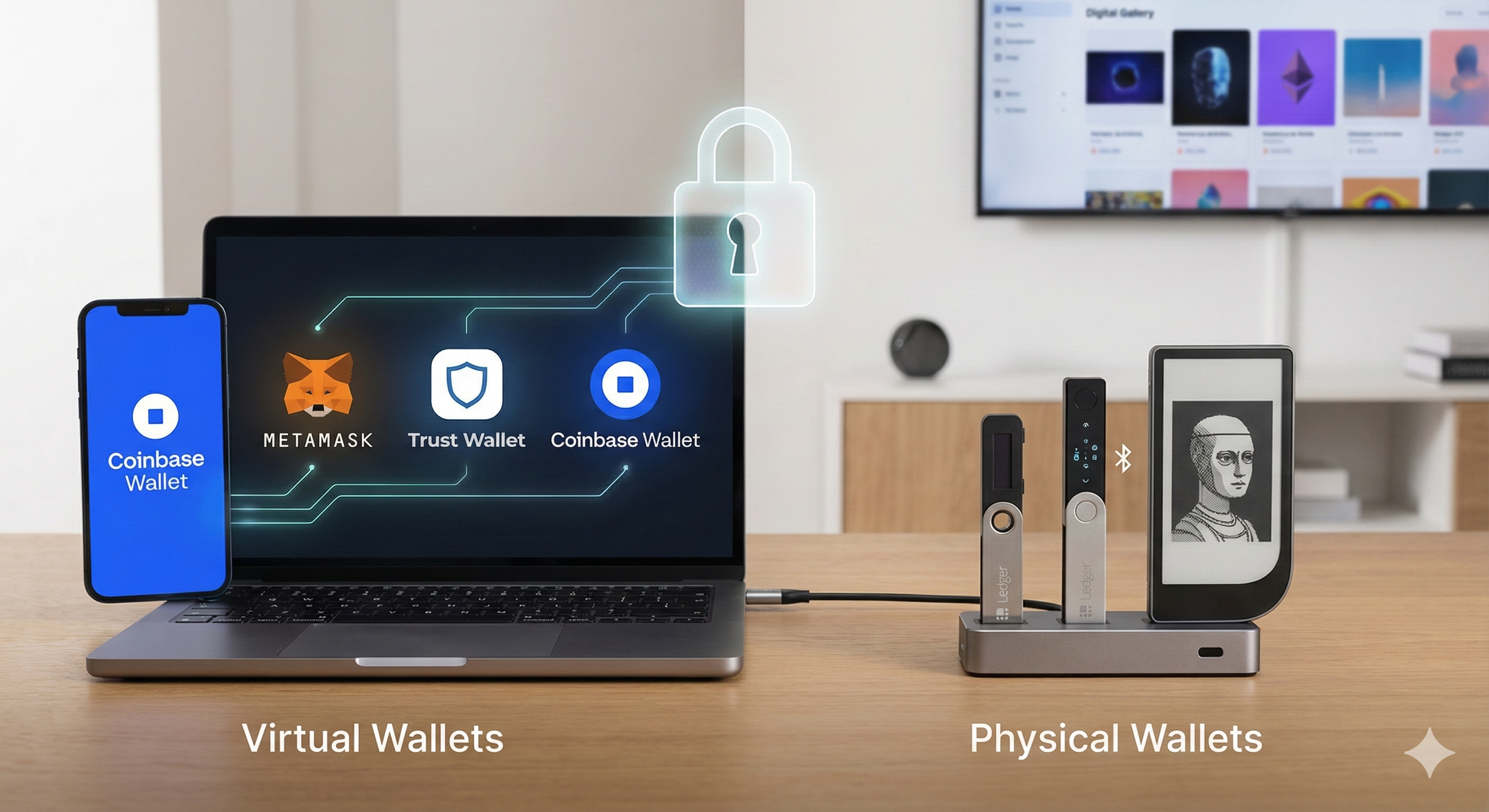
It is important to store these valuable items securely to prevent loss or theft.
There are several ways to store them, each with its own advantages and disadvantages, but they all have one thing in common: they are called “wallets” in English.
There are two types of wallets: virtual wallets and “physical” (hardware) wallets.
Virtual wallets
A virtual wallet, also known as a software wallet, is a type of wallet that allows you to store, send, and receive cryptocurrencies and NFTs via a computer or smartphone using software or a mobile app.
There are many virtual wallets available, but the most popular ones are MetaMask, Trust Wallet, and Coinbase Wallet.
Although these wallets are considered less secure than physical wallets, they are often more convenient to use because they can be accessed remotely.
Physical wallets
A physical wallet, also known as a hardware wallet, is a type of wallet that allows you to store private keys. These wallets are physical devices that store your private cryptographic keys offline, making them less vulnerable to hacker attacks.
They are generally compatible with multiple blockchains and have screens for verifying transactions. The best known are the Ledger Nano S and Nano X. These are physical wallets developed by Ledger, a French company specializing in cryptocurrency security.
- The Ledger Nano S is Ledger's basic model. It is equipped with a small screen and buttons to verify and validate transactions. It has limited storage capacity and no wireless connection.
- The Ledger Nano X is the high-end model. It offers the same features as the Ledger Nano S, but with higher storage capacity and Bluetooth connectivity for use with mobile devices.
- The Ledger Stax is the new high-end model. It will be released in April 2022 and features a 3.7-inch curved E-Ink touchscreen that allows NFTs to be displayed on the locked screen. It offers the same features as the Ledger Nano X.
Physical wallets are considered more secure than virtual wallets due to their hardware security, but they can be more difficult to use due to the need to connect the device to a computer to perform transactions.
In summary, virtual wallets are accessible via a computer or smartphone, while physical wallets store your private keys on a physical device. Virtual versions are convenient but less secure, while physical wallets are more secure but a little more difficult to use.